Welcome to my blog!

I'm an acupuncturist, teacher, fertility specialist, patient centered advocate, mom, activist and more! This blog is a place for me to write down the things on my mind, the things I discuss over and over, and the things I find helpful, interesting, and inspiring all in the hope that someone else out there, maybe YOU, will find some of these things to be helpful, interesting and inspiring too. I love learning, I love sharing, and I am passionate about helping others lead more balanced, fertile, and healthy lives - while trying to do the same myself. So here goes... The Blogging Life...
Showing posts with label General Health. Show all posts

4.16.2014

Type 3 Diabetes - Alzheimers

One aspect of this "new" (to me!) approach to diet that is really powerfully resinating with folks I'm talking with is the idea of Alzheimer's disease being linked to insulin issues. If that aspect of this discussion is of interest to you here are a couple links you may like:

Here is a nice piece from the New York Times blog by foodie Mark Bittman about it (he has some further links in his piece too).

and, if you are interested in the more technical aspects...

Here is a link to the National Center for Biotechnology Information's review of the data on the hypothesis that insulin plays a role in Alzheimer's which concludes:


Conclusions

Altogether, the results from these studies provide strong evidence in support of the hypothesis that AD  [AD=Alzheimer's Disease] represents a form of diabetes mellitus that selectively afflicts the brain. Positive data stemmed from (1) direct analysis of postmortem human brains with documented AD; (2) an experimental animal model in which brain diabetes with cognitive impairment and molecular and pathological features that mimic AD was produced by intracerebral administration of a drug that is commonly used to produce T1DM or T2DM; and (3) a study showing that PPAR agonists, which are used to treat T2DM, prevent many of the AD-associated neurodegenerative effects of ic-STZ. The data are supported by abundant in vitroexperiments that demonstrated essentially the same or similar effects of STZ or oxidative stress treatments of neuronal cells. The human and experimental animal model studies also showed that CNS impairments in insulin/IGF signaling mechanisms can occur in the absence of T1DM or T2DM. Finally, we demonstrated that although obesity with T2DM causes brain insulin resistance with some features of AD-type neurodegeneration, the effects are relatively modest, not associated with significant histopathological lesions, and lack most of the critical abnormalities that typify AD. Therefore, T2DM was deemed not sufficient to cause AD, although it could possibly serve as a cofactor in its pathogenesis or progression. Altogether, the data provide strong evidence that AD is intrinsically a neuroendocrine disease caused by selective impairments in insulin and IGF signaling mechanisms, including deficiencies in local insulin and IGF production. 


4.03.2014

Podcast - Salt, Sugar, Fat and a Breakfast Idea

Check out this podcast from the good folks at America's Test Kitchen with pulitzer prize winner and author Michael Moss about the industry of junk food in America (Starts at 15:50 marker).  So interesting, and as he states (in so many words)... knowledge is power!

A quick yummy breakfast idea if you are trying to decrease your carbs... I stumbled into this one today:

1/4 cup full fat vanilla yogurt
1 Tablespoon natural salted peanut butter
about 12 frozen raspberries

HOLY MOLY!  SO yummy... I could eat this as a treat... and it's about 12g carbs with the brands I used (check your own).

I ate this with a soft boiled egg with a little organic herby blend seasoning by frontier seasoning blends and a cup of tea.  Perfecto!

Nicole

3.31.2014

Food & Diet Part 2

So this is the slide that Marlene Merritt LAc. DOM (NM), ACN of Merritt Wellness Center started her lecture with. And the info below is my summarizing and expounding on the concepts she covered. What I especially liked about her talk is that it appealed to both my logical brain and the sense of honoring and trusting what history and experience can reveal (something that is a BIG part of Traditional Chinese medicine). 

To understand the basic lifestyle and dietary changes Marlene's lecture was ultimately advocating please see my first post, which contains links to her youtube videos where she explains the concepts herself. This post is about more support and follow-up info: historical evidence and modern scientific support.

I'd like to start by acknowledging that this is a departure from my previous recommendations, because it is NOT entirely based on chinese medicine food therapy. And while I still do advocate for many of the concepts in TCM food theory (namely focusing on increasing your food's ability to be cooked down by your digestive kettle by doing things like eating more cooked foods, chewing well, slowing down, eating smaller meals more frequently, enjoying food mindfully, being moderate, eating seasonally and locally). This post definitely represents a shift from a purely TCM recommendation to more of a hybrid. 

Why, you ask?  Because one of the very interesting things Marlene pointed out is that different populations have evolved to eat different foods (in our digestive tracts). Yes, in Asia there is a lot of rice and soy and no dairy and yes, eating this way is what TCM food therapy recommends, but most of my patients are not of Asian descent and so our guts have evolved to eat what was traditional in the places we came from. In European countries for example, dairy was much more common (especially Scandinavian ones), in Africa it was not.  So this really puts some perspective on everyone eating the same foods... it just doesn't make sense from an evolutionary perspective. We have different guts and different abilities. This does still go with the TCM concept of listening to your own body above any one rule.

The History
There was a man named Weston Price who has been called the Isaac Newton of Nutrition. He was a dentist and a vegetarian and in the 1930s he went and searched the world to find a healthy vegetarian culture. He went to cultures all over the world and used the powers of observation to come up with basic assertions. Although he did not find any healthy vegetarian cultures, he did find indigenous cultures that had much higher levels of health (when you took away illnesses and accidents that would be readily preventable and treatable in the west), fertility and ultimately nutrition. 

These traditional diets were much more like our own ancestors and included:

Foods grown in nutrient rich/fertile soil 
ALL the parts of animals including organ meats, marrow)
Animal fats
Animals on pasture
dairy products that were raw and/or fermented
grains and legumes that were soaked or fermented 
and bone broth
only real foods found in nature

Our modern diets includes:

Foods grown in depleted soil
muscle meats (which are the least nutritious parts of animals) 
vegetable oils
Low Fat
Animals raised in confinement
pasteurized dairy
refined and or extruded grains 
WAY more grains than would have traditionally been available
lots of artificial and synthetic foods

So basically, as time went on and we had the luxury of not having to worry about starving and had more science, agriculture and politics enter into our food arena. Much of the traditional diet went out the window.

In the 1800s people averaged 18 lbs of sugar per year
In the 1900s it went to 90 lbs per year
In 2010 the average american consumed 120-150 lbs of sugar per year and 50% of americans consume a half a pound of sugar per day.
see USDA Agricultural fact book, profiling food consumption in america, pg. 20. www.usda.gov/factbook/chapter2.pdf

Yet, the FDA has NO recommendations on sugar intake, it has it for fat (especially saturated fat).

Since the 1950s the US food pyramid has advocated for less fat and more carbs (but, carbs are ultimately sugars: so simple and complex grains, fruits, legumes and actual sugar all are increasing our blood sugar)

And the typical american eats between 300-600 grams of carbohydrates per day... The American diabetic association recommends the reduction down to 45-60g PER MEAL. But the human body can only actually possibly use and process about 60-100 grams of carbs per day.

So the body is resilient and amazing and can make it look like it is coping for a long time even though it is in stressed out, coping mode day in and day out... really, the human body is AMAZING!  The things we can do to it and that it will tolerate for YEARS!  (that's not to say they won't catch up with us, individually and culturally)... 

By the time we are 65, 77% of people are diabetic or pre-diabetic 
us centeres for disease control and prevention 2011 
US dept. of health and human services, national diabetes information clearinghouse, fast facts about diabetes, 
http://diabetes.niddk.nih.gov/dm/pubs/statistics/#fast, 2011

American's are getting fatter and fatter... for years the statistic was 1 in 7 americans was obese and this statistic was stable for decades and decades... but with modern diets the rates are quickly jumping up... so that in 2012 most of the US was one out of 3 or 4 and the projected rates for 2030 are that most of the states in the US will have at least 1 out of every 2 people categorized as obese (NOT overweight, but obese!)


Clearly, cutting out fat isn't the answer. Weston Price showed lots of healthy indigenous cultures who ate lots of foods that we look at as unhealthy but they were actually healthy. AND the actual statistics show that despite eating less and less fat, we are getting fatter and more unhealthy.

If you want more big picture evidence, look at the lower rates of heart disease associated with higher levels of saturated fat in the diet in the modern french, swiss, dutch, icelandic, belgium, finnish and austrian cultures!
european cardiovascular disease statistics

And for those of you who like the research based approach check out these: 

The Framingham Study (Archives of internal medicine, jul 1992, 152(7), 1371-1372)
showed that the more saturated fat and cholesterol one ate, the more calories one ate, the lower people's serum cholesterol was.

And the follow up 30 years later which concluded that lower cholesterol equaled a greater risk of death. "For each 1% ml/dl drop of cholesterol there was an 11% increase in coronary and total mortality." Anderson, leaven M., William P. Castelli, and Daniel Levy. "Cholesterol and mortality: 30 years of follow-up from the Framingham Study." Jama 257.16(1987):2176-2180 l

And it doesn't get much more clear and damning than this: "Those individuals with a low serum cholesterol maintained over a 20 year period will have the worst outlook for all-cause mortality."
Schatz, Irwin J., et.al. "Cholesterol and all cause mortality in elderly people from the honolulu heart program: a cohort study." the lancet 358.9279 (2001): 351-355

But those are just on cholesterol, how about this:

"In studies conducted over 20 years, the Harvard School of Public Health showed that total fat intake bore no significant relation to coronary Artery Disease risk... epidemiological studies have shown no evidence that men who eat less fat live longer or have fewer myocardial infarctions"
Hooper, L., et. al. "Reduced or modified dietary fat for prevention of cardiovascular disease." Cochrane Database Syst. Rev 2 (2000)
Mozaffarian, Dariush, Renata Micha, and Sarah Wallase. "Effects on coronary heart disease of increasing polyunsaturated fat in place of saturated fat: a systematic review and mata-analysis of randomized controlled trials." PLos medicine 7.3 (2010): e1000253

or for Women:

"In women and in the elderly, no appreciable difference in coronary heart disease rate for any level of cholesterol. In fact, for women of all ages and the elderly, higher cholesterol is associated with longer lifespan.
Circulation medical journal 86, 1026-1029, 1992

And this one has been in the news, because it was just released 2 weeks ago: in over 500,000 subjects the conclusion was that decreasing saturated fats should not be encouraged!
Chowdhury R. et al. Annals of Int. Med. 2014, March 160(6) 398-406

So why is cholesterol actually not so bad?
In addition to being a basic building block for many of our cells (it is part of cell membranes), It acts as a bandaid to fix up cellular damage and if we don't have enough our cells can't repair. Leaving our bodies more prone to damaged cells turning into problems. 

Cholesterol is also a precursor to many hormones and Vitamin D, so when you decrease it, you mess with those. 

It helps fight infection and it protects against depression and helps your nervous system deal with stress. So much so, that one study showed people who relaxed prior to blood draws had lower cholesterol than they did on days when they were stressed prior to blood draws.

So, there is SOOOO much more I got from these talks and more I will definitely be discussing with patients, friends and family, but for now, I'll give a few closing tidbits:

If you want more information on the diet changes Marlene Merritt suggests it is basically the Weston Price approach Which you can read about at length here PLUS specifically limiting your carbs to under 100g/day ideally more around 60 is the goal... Remember, doing what you can and making some changes is better than doing none and sticking with the low fat, high carb approach. 

A thought provoking article from the Atlantic about medical research and the fads/bad info they can result in.


and if you've made it this far... way to stick with it!  Thank You...

on McDonalds French Fries, Saturated Fat and Flavor!

PS. For those who are vegetarian or vegan and may site the China Study (Book, not actual study). There were shown to be over 8000 correlations in that study and one of the authors of the actual study went on to publish several other papers stating animal protein is not harmful. Here is the Weston A Price foundation's page on info for you


Dietary Recommendations - Going Off the TCM Grid

Those of you who know me know I am NOT a fan of anything that is extreme, immoderate, unsustainable or crazy-making. I've seen plenty of studies on XYorZ and fertility or general health and advocated against doing them (often for more than just the crazy-making piece- see cartoon below!)


This weekend I went to a symposium with 400 other acupuncturists and herbalists. I had the pleasure of seeing one of the TCM rock stars of today and delving into the philosophy, history and even spiritual aspects of the medicine, another practitioner presented on the newly "discovered" aspects of chinese herbal medicine's biochemistry. There were also TWO sessions (one taught by an RE and one by and acupuncturist/functional medicine doc) on insulin resistance and the American diet. The RE's focus was on PCOS and fertility and the acupuncturist/functional medicine doc was on navigating traditional chinese food therapy, history, modern lifestyle and HEALTH.  Although they both ended up suggesting dietary changes that do have the possibility of being a bit crazy-making, I feel like the benefits and proof (both scientific and historically - more to come on both of these)  REALLY made me want to give this a try with my own family.

I of course, realize there is no one size fits all approach, but I think this really has some chops and hope you'll consider it too. We ALL are living in a culture where obesity, type 2 diabetes, and health related problems are on the rise (did you know by 2030 the projected obesity rate for most of the country is 50-70%?). And especially if you are dealing with PCOS, blood sugar concerns, weight issues or worried about inflammatory illnesses (from digestive problems to cancer) this is something worth looking at and thinking about.

Because I am a newbie at all this, I'll let the acupuncturist/functional medicine doc lay it all out for you!
And I'll be following up this post with the studies and citations for you to look at if you want the science.

Each one is under 10 minutes long and she can explain SO much and so well... instead of watching one primetime show, check it out and see what you think!

Start with this video
To understand what happens when you eat

Watch this one 2nd
To understand why eating certain diets and the modern lifestyle fuel inflammation, heart attacks, PCOS, Cancer, Alzheimer's (not to mention diabetes)

And how to reverse these issues and feel better!
Yaaaaay!  It might seem challenging, but it is TOTALLY empowering AND makes sense when you look at history and just getting back to old school eating. (Sad that it actually seems so very different than what we do today).

And if you want to see the difference between different common diets you can watch this one as a bonus :)

See my next post if you want some of the citations as well as the historical perspective!

3.24.2014

Fevers Myth Vs Fact


I have mentioned this article to lots of patients and thought I'd post it here for ease :)

Fever - Myths Versus Facts

\
Misconceptions about fever are commonplace. Many parents needlessly worry and lose sleep when their child has a fever. This is called fever phobia. Overall, fevers are harmless. Let the following facts help you put fever into perspective:  
MYTH: My child feels warm, so she has a fever.
FACT: Children can feel warm for a many reasons such as playing hard, crying, getting out of a warm bed or being outside on a hot day. They are “giving off heat”. Their skin temperature should return to normal in 10 to 20 minutes. Once these causes are excluded, about 80% of children who feel warm and act sick actually have a fever. If you want to be sure, take their temperature.  The following are the cutoffs for fever using different types of thermometers:
  • Rectal, ear or temporal artery thermometers: 100.4° F (38.0° C) or higher
  • Oral or pacifier thermometers: 100° F (37.8° C) or higher
  • Under the arm (Axillary or Armpit) temperatures: 99° F (37.2° C) or higher
MYTH:  All fevers are bad for children.
FACT:  Fevers turn on the body's immune system and help the body fight infection. Fevers are one of the body's protective mechanisms. Normal fevers between 100° and 104° F (37.8° - 40° C) are actually good for sick children. 
MYTH:   Fevers above 104° F (40° C) are dangerous and can cause brain damage.
FACT:  Fevers with infections don't cause brain damage.  Only body temperatures above 108° F (42° C) can cause brain damage.  The body temperature climbs this high only with extreme environmental temperatures (for example, if a child is confined to a closed car in hot weather).
MYTH:  Anyone can have a febrile seizure (seizure triggered by fever).
FACT:  Only 4% of children can have a febrile seizure.
MYTH:  Febrile seizures are harmful.
FACT:  Febrile seizures are scary to watch, but they usually stop within 5 minutes.  They cause no permanent harm. Children who have had febrile seizures do not have a greater risk for developmental delays, learning disabilities, or seizures without fever.
MYTH:  All fevers need to be treated with fever medicine.
FACT:  Fevers only need to be treated if they cause discomfort.  Usually fevers don't cause any discomfort until they go above 102° or 103° F (39° or 39.5° C).
MYTH:  Without treatment, fevers will keep going higher.
FACT:  Wrong.  Because the brain has a thermostat, fevers from infection usually don't go above 103° or 104° F (39.5°- 40° C). They rarely go to 105° or 106° F (40.6° or 41.1° C). While the latter are "high" fevers, they are harmless ones.
MYTH:  With treatment, fevers should come down to normal.
FACT:  With treatment, fevers usually come down 2° or 3° F (1° or 1.5° C).
MYTH:  If the fever doesn't come down (if you can't "break the fever"), the cause is serious.
FACT:  Fevers that don't respond to fever medicine can be caused by viruses or bacteria.  It doesn't relate to the seriousness of the infection.
MYTH: Once the fever comes down with medicines, it should stay down.
FACT: The fever will normally last for 2 or 3 days with most viral infections.  Therefore, when the fever medicine wears off, the fever will return and need to be treated again.  The fever will go away and not return once your child’s body overpowers the virus (usually by the fourth day).
MYTH: If the fever is high, the cause is serious.
FACT:  If the fever is high, the cause may or may not be serious. If your child looks very sick, the cause is more likely to be serious.
MYTH:  The exact number of the temperature is very important.
FACT:  How your child looks is what's important, not the exact temperature.
MYTH:  Oral temperatures between 98.7° and 100° F (37.1° to 37.8° C) are low-grade fevers.
FACT:  These temperatures are normal variations. The body's temperature normally changes throughout the day. It peaks in the late afternoon and evening. An actual low-grade fever is 100° F to 102° F (37.8° - 39° C) .
SUMMARY: Remember that fever is fighting off your child's infection. Fever is one of the good guys.
Author and Senior Reviewer: Barton D. Schmitt, M.D.
Content Set: Pediatric HouseCalls Symptom Checker
Pediatric HouseCalls Symptom Checker

3.05.2014

Dermatologist Referral

I have been referring to a dermatologist named Lynda Kauls for a while. She was with a bigger group and branched out on her own a year + ago.  I only just now wandered onto her new website and really liked what I read.  It only affirms why I like referring to her!

Check Her Out


8.28.2013

It's the sneeze sneeziest time of the year!

Are you snotty, sneezy, and itchy?  This time of year is when my allergies go berserk and I am forever and deeply grateful for what has become a routine part of my day during allergy season... my neti pot.

The other day I think I scared our babysitter by exclaiming I just had a neti pot induced orgasm, but truly, there was no other way to say how completely unbelievable the feeling of going from stuffy and snotty to feeling free and spacious in your head via a lovely warm stream of water running in one nostril and out the other feels. It is amazing! I won't even get into how grossly superb watching all the globs of snot wash out of your own head and down the drain is (okay, I guess I just did).

Yes, I do realize it sounds like some form of torture. Yes, I too thought I would NEVER ever willingly pour water up my nose. Yet still, I got desperate enough took the leap and.... well, neti induced orgasms are AWESOME!!!

So check out this past post I did all about the Neti and go get yourself one today, if you are full of snot, have itchy eyes, sneeze a bunch, have a tickly throat, or any other allergy symptom bugging you (or you suffer from sinus infections) you will never look back!


8.11.2013

Under Pressure

Cue the queen song... "pressure pushing down on me, pressing down on you, no man asking for..."  (and yes, I'm aware it might be stuck in your head all day... you're welcome!)

Lately a theme of my own life, as well as my work (funny how that works!) has been pressure. I hear it so many ways and see it so many places, but it all comes down to this. The feeling that there is an immediate need or demand for your attention or action. Something that cannot wait. Something that must be done. No ifs ands or buts. I mean NOW!

Only problem is, there's always a steady stream of these demands. These pressures. And so it becomes this horrible, never ending I HAVE to do this or (ominous music)... dum dum duuuuuum... way of living.

And what is the one thing that NEVER has to be done? The one thing that there isn't one single immediate effect if you put it off?  (job - nope, finances - nope, housework - nope, errands - nope, email and texts - don't get me started!)

The one thing that can always be put off is down time.

No one ever says, "Well, Shit!  My boss is totally going to ream me out because I didn't take some ME time."  or "Oh my god, I can't believe I completely forgot to just relax today, what's wrong with me?!" "Hold on, I've got to put 'sit around and relax' in my calendar so I don't forget!"

Imagine a world where you might say, "If I don't just chill out, then WHO, I ask you WHO WILL?!"  or how about a world where you get in a fight with your partner, "Why am I always the one who has accomplish absolutely nothing?"

I wish we lived in a different world.

Because the truth is, someone IS going to have a major problem with your lack of self care. And something really IS going to give due to your complete lack of dedications to this part of your life, but it won't be right away, and it won't feel like a direct consequence. Even though it is...

That someone is YOU and that something is your health (and likely your relationships, your sanity, your quality of life...) None of these are going to call you into an office and tear you a new one (or if they do, count yourself lucky and LISTEN to what they are saying for the love of all things holy!) but if you keep listening to all the immediate needs, all the pressure. You WILL have problems, maybe not today, but eventually.

I hope you'll think about it and make some changes. It really is worth it, and if enough of us can lead by example, it might just catch on. Wouldn't that be a lovely thing! It's funny what a domino effect this can have and it feels so good if you can just get in the habit of it and make it a priority.

And one more thing... if you haven't done this and you aren't used to it, it'll likely freak you out for a while. You might feel like relaxing is harder than continuing to go full tilt. Stick with it. You'll get the hang of it once your brain and your body feel like it's familiar and not some weird unknown threat. Practice makes perfect!

Nicole

7.18.2012

Body Brushing


What do you know about your lymph system?

okay, okay, sock it to me guys!  I can only imagine what some of you might be thinking...

not a hell of a whole lot.
WHY would I need to...
Little to none and I'm fine with that thank you.
Oh no, here's where she starts with the really out there natural stuff!

I get it!

But you do realize you are talking (well sort of) to a self proclaimed science/biology uber geek right?!  Just because I do eastern medicine does not mean for one hot second that I feel it isn't important to know and teach others interesting facts including....

Each person's body contains between 500 and 700 lymph nodes which are tiny organs. 

There are more concentrated clusters of lymph nodes in your groin, underarms and neck.

The lymphatic system is (in my world LOVINGLY) sometimes referred to as the sewage system of the body.

The lymphatic system is connected and fluid flows from lymph node to lymph node but only travels in one direction and since there is no pump to move the fluid it is dependent on being physically squeezed by muscles and tissue around them (which movement and massage can assist with).

Okay, either you're with me or I've lost you at clusters in your groin... (Cue the Jerry McGuire type moment where this line is applicable!)

So why do I care about the lymph system you ask?
Well, (in all seriousness) because my own Grandmother died from Lymphatic Cancer waaay too young (just 42 years old, which feels like I'm just around the corner from!) and from a very young age I've been borderline (if I can't lie a little bit to make myself less crazy on my blog where can I?) obsessed with a fear of following in her footsteps.  Thankfully, studying chinese medicine gave me a huge reprieve from that obsession and I now think of it very very differently (another blog post I think!) BUT, that said, it still doesn't mean that I feel like I shouldn't be proactive where I can be.

Enter dry brushing to promote lymphatic drainage and movement.

Sounds exciting right?!

Oh, the story I could tell here!  Let me give just the brief version and share that the first time I ever experienced body brushing it was at a tres fancy spa at a retreat in Austin TX, where a middle aged man body brushed me raw all the while sharing with me that he was once a suspect for the "mailbox bomber."  Because nothing says, $200 massage like a discussion about the FBI and homemade explosives am I right!  (How do you gauge how much to tip on that one...)

But after a long swearing off period I learned more about body brushing and now it's a simple, quick, and lovely part of my routine.  

So here's the quick and lowdown...

If you move your body in certain ways and/or massage, brush or basically compress certain areas it gets your lymph moving more that in otherwise would.  Because the lymphatic system is responsible for detoxing your body and healthy immune response and because the lymphatic system has a tendency to lack movement, gather gunk and yucky accumulations (including potentially cancerous cells) it is nice to help it out. It helps your immune system function in a healthy and balanced way, clears out the gunk...

PLUS, dry body brushing...

-increases circulation to your largest organ - your skin - and make it healthier and more radiant
-decrease dry skin
-may help decrease cellulite by helping breakup and redistribute fat deposits in the skin
-helps calm and regulate the nervous system by gently stimulating nerve endings
-improve muscle tone
-help your body wake up

So here's what you do....

1) Get a nice brush (they aren't expensive) with natural bristles something like 
2) BEFORE you shower or bathe (skin should be bare and dry) use the brush and brush from your extremities towards your heart.  Being sure to spend extra time and sweep over and past the areas where the majority of the lymph nodes are (groin, armpits & neck).  *GO all the way from your arms over your armpits and to your torso for example*  You are essentially brushing towards your heart where the subclavicular drainage areas are that drain the gunk out of the lymph system for excretion.  

3) Avoid brushing any areas that are red, rashy, etc.  and brush as softly or with as much pressure as is comfortable aka use your own good judgement.

4) Ideally this should be done before showering daily or however often you shower, but don't beat yourself up if you do it when you can that's great!

5) Shower as usual :)  (and take your brush in to rinse off dead skin and gunk every so often too!

If you want to watch a simple video start with this one:

There are lots of other more in depth patterns and videos with info online too, but you know me... I like quick, moderate and sustainable over elaborate and exhausting!


PS. If nothing other than loving the fact that someone made a website called LymphNotes.com I feel compelled to share the link with TONS of other western type lymph system info, feel free to geek out and join me!

6.23.2012

Hair, Skin and Beauty Naturally. No Chemicals Needed.

Hello my eco-conscious, body aware readers!

While many women are very very conscious about what they put IN their body - eating organic, local, and whole foods when possible, trying to limit artificial or processed foods - much fewer are focused on what they put ON their body.  I'd like to make an argument for why that might be worth rethinking!

Did you know that we absorb up to 60% of whatever we apply to our bodies?
...That our underarms and genitals absorb up to 100%(Kasting, 2005)
...That our face is anywhere from 2-6 times more permeable than the torso
...That fragrance ingredients show a 100% absorption rate (Robinson et al, 2000)
...That the average woman wears over 500 (!!) chemicals on her body in a given day??


And I think really and honestly, we KNOW this, we KNOW we shouldn't be putting things with all sorts of crazy chemicals that we can't pronounce all over our bodies, but let's face it (pun), sometimes finding natural products that actually work well feels impossible (raise your hand if you've tried that crystal deodorant... wait, on second thought Don't raise your hand - pew!!)  Dare I say, natural mascara?  Ugh.

Well, here's a good starting off point.  I've used these products, I know they actually work and I invite LOTS and LOTS of comments if you have products you can personally endorse!

SOAPWALLA Deodorant cream
I'm a hot hot girl from a TCM perspective which means I am blessed with the TCM pattern of imbalance that equates to the stinkiest sweat.  This is the only natural deodorant I've ever been able to use with success, I trust it so much I don't even have to break out the chemical stuff when I'm doing a big presentation! It's by FAR the best natural deodorant I've ever tried (and I've tried LOTS that do between absolutely nothing and minimal).  I'm even a vendor I love this stuff so much!

EccoBella Cosmetics
The mascara and cover-up in particular are FABULOUS!  Flower pigment, organic, animal friendly and they look and wear great!

Intelligent Nutrients Hair Care Products
This is the new line from the original creator of Aveda products.  Everything in these hair care products could be eaten (But you may want to take my word for it, that just because you could eat it, doesn't mean it tastes good - gah!)  The harmonic shampoo is by far the BEST shampoo I've ever tried (and my sister is a hair stylist, so I've tried lots of the fancy schmancy salon stuff)  My hair is very fine and with this shampoo I don't even use conditioner.  It smells minty and wonderful and I use it to cleanse both my hair and whole body.  It isn't tear free, but I use it on my kids too, I'd rather use things that are edible and natural on them then worry about things being tear free!  (If you try the hairspray and dare to spritz it in your mouth let me know-I've heard stories!)

Earth Mama Angel Baby Products
They have products for pregnancy, postpartum and babes (and honestly they'd be great all the time for anyone!)  They are ZERO toxin (the only line for babies like this to the best of my knowledge-which is sad to me!)  They have some very lovely products to help support grieving mamas who have lost babies too which I love about them!

Coconut Oil
Okay, this one is not fancy at all, but I LOVE IT!!  I use cold pressed, organic coconut oil instead of body lotion. It is light, doesn't take forever to dry, smells good (if you like coconut), and is practically a  science experiment because it is solid at or below 70 degrees but as soon as you start rubbing it between your hands or on your body it melts to a liquid... super cool for a geeky girl such as myself!

Sunscreen
I think there are a lot of nice natural ones out there, but I use mostly Jason and Alba Botanica because they don't break the bank!

All Terrain Bug Spray
I'm already risking sounding overly dramatic with my ALL CAPS and exclamatory remarks, but PEOPLE, LET ME TELL YOU!!  THIS IS A NATURAL BUG SPRAY THAT ACTUALLY WORKS!!!  Mosquitos love my blood, it's like Thanksgiving dinner to them, put me in a group of people with each person averaging 3 bug bites and I'll come out with 15...  I only wish I were exaggerating!  This stuff is AMAZING.  I think I'm going to try their sunscreen next time I need more too!

Those are the things I use regularly!

And if you are feeling a) in the mood to try some things on your own or b) scared into rethinking your current products (sorry, but hey!) Here is just one of what I'm sure are many other nice websites that sell natural/organic skin and beauty products that you might like to check out! Have fun trying some new things!

http://www.spiritbeautylounge.com/

Nicole

And a little update...

Thanks to a lovely reader who emailed me with this AMAZING LINK http://www.ewg.org/skindeep/ where you can actually look up your skin/beauty products and see them rated and broken down by categories including:

Health concerns of ingredients 
Overall Hazard 
Cancer 
Developmental & reproductive toxicity 
Allergies & immunotoxicity 
Use restrictions


And if all this weren't enough... check out this scary (and huge) 
info graphic...

8.31.2010

Practitioners & Providers

I recently sent out an email to past & present patients asking for their feedback on the practitioners or providers they love... or like a lot!  I specifically asked for those who were open-minded and supportive of a more holistic view.  I hope this list will grow and grow and welcome your feedback!

All quotes are taken directly from feedback I received from patients....

OBGYN/MIDWIVES
Dr. Patricia Chang (allina Parkview clinic) specializes in difficult pregnancies, vulvar disease, bladder incontinence surgeries, laparoscopy and adolescent and pediatric gynecology. "She TOTALLY gets the big picture, more than open minded, actually encouraged holistic methods like acupuncture, also has a lot of heart, recognizes me when she sees me, follows up, shows emotions instead of seeming distant and unfeeling. Can't say enough!"
Dr. Andrea Flom (Haugen Associates in Edina): "very nice, woman.  Good for general OBGYN.  Not aggressive in telling you what to do / not to do."
Dr. Jennifer Ramsey (Fairview-Riverside Women's Clinic) Midwife "Did an awesome intake and is a big fan of holistic/alternative medicine."
HealthEast Midwives - Although the level of holistic varies from woman to woman, this is a fantastic group with some amazing and supportive practitioners.  Kerry Dixon in particular is one of the most compassionate and whole person practitioners I have ever met.  These midwives deliver at St. Joes and Woodwinds, two of the lowest intervention and most supportive of natural birth hospitals in the area.  Water births, doulas, etc. are very welcome and supported here.  The clinic on Grand Avenue in particular has the friendliest support staff I've ever encountered and the whole visit experience is lovely.  Plus it's in a great location with validated parking, good places to have lunch after appointments :)
HCMC Midwives - The WHOLE group :) "An awesome group of women dedicated to great births.  This group also does group prenatal care "centering groups" which is a wonderful way to connect and feel supported throughout a pregnancy."
Dr. Mainguy (Women's Health Specialists in Minneapolis) "I've enjoyed all the practitioners in this group.  They really know their stuff especially when it comes to 'high risk' pregnancies."
Dr. Judith Stark (southdale Obstetrics & Gynecology Consultants) Mpls St. Paul Magazine and MN Monthly top doc.  Very open-minded!

GENERAL PRACTITIONERS
Dr. Mirtha Nesheim (HCMC South) "She has a more global view of Western medicine which translates to being an amazing practitioner.... she listens, explains, never talks down, is thoughtful in her approach, knows her stuff, but isn't quick to push intervention or medication when there are equally effective and less risky alternatives."
Dr. Mary Cady (Allina in W. St. Paul) a GP who specializes in OB & peds She is very open minded about holistic healing, "I believe she goes to an acupuncturist herself and always has holistic/herbal ways to treat things other than antibiotics and other meds."
Dr. Brett Adams (Highland Park Fairview) "Respects my opinion about my own health, always takes more than enough time to answer all of my questions, talk about diagnosis, etc."
Dr. Kevin Kelly (Riverside Family Physicians) "more than your average doctor he prescribed me an autobiographic book - after I came to him with questions about breast cancer."

PEDIATRICIANS
Dr. Jaeger (central Pediatrics) This clinic is great as a whole "we specialize in busy families," it is an entirely pediatric practice and has daily walk in hours for sick kids no appointment needed.  After hours the clinic (same 2 locations) becomes afterhours clinics, so you can often bring your child to the same building and get care (billing is just adjusted accordingly)   Dr. Jaeger is the most supportive pediatrician of attachment parenting I have encountered.  She is warm and compassionate and supportive of natural and/or noninvasive treatments. She is overall very calm and supportive of a holistic approach.
Dr. Susan Goodale (Central Pediatrics) A mother of 4 daughters herself, she is open minded "She will give you both the Mom answer and the doctor answer!"
Dr. Sonja Hinrichs (Southdale Pediatric Associates) "The mother of twins who strives to find the best balance for her own family, life and career, she is definitely passionate about helping other parents (especially of multiples!)"

PERINATOLOGIST
MN Perinatal Specialist:
Should you make the difficult decision to have an amnio:
Dr. Bendel @ MN Perinatal Specialist is very experienced, has done thousands and in his semi-retired state it is almost exclusively what he does!


HOLISTIC HEALERS
acupuncture
Lindsay Long (maple grove)  Has a passion for musculoskeletal concerns... aches, pains, injuries and the like!  "If you're in pain, Lindsey can work wonders!"
Sarah Larson (Langford Chiropractic St. Paul) for personal injury, auto accident, workers compensation injuries, Sarah can be seen alone or as part of a team (acupuncture, chiro, massage and more) she is "a caring and compassionate practitioner who always makes my day a little brighter, Sarah is just one of those people who is a joy to be around."
Amy Theis (Heal OM Minneapolis, MN) Amy has worked closely with me (Nicole) and cared for my patients while I was on my own maternity leave.  She is an amazing person, skilled practitioner and is the very best resource in the twin cities when it comes to her two areas of extra interest: GLBT reproductive and fertility concerns and choice moms
Senia Tuominen (Healing Insight St. Paul) If you like the education, patient focussed care of Life Healing Life but are not trying to conceive or pregnant Senia is a wonderful resource.  With a special interest in digestive concerns and food therapy. "Senia has so much knowledge, drive and passion for the work she does."

bodywork
Liv Sulerud (Bodywork by Liv in S. Mpls) A great general massage therapist with a lovely space and training and experience in pregnancy massage
Autumn Compton (Riverpath Clinic in Longfellow neighborhood of Mpls) Tui Na (chinese massage) Shiatsu (Japanese massage) therapist, with training and experience in pre and perinatal massage, also an artist, dancer and qigong enthusiast.
Spark Clinic A HOLISTIC walk-in clinic!!!  What a concept!  For all your acute needs... think colds, earaches, bumps bruises, and much much more.  You can get homeopathic remedies, acupuncture, bodywork and much more.  Now offering tai chi classes too!
Adagio Massage & Mayan Abdominal Massage An amazing resource for body work that can scope from completely blissful pregnancy massage to specific work to realign the reproductive organs for improved fertility, better periods and more.  A very talented group of practitioners that each brings something unique and wonderful to each experience.

chiropractors
Stacy Meschbesher (Meshbesher Chiropractic Center, Minneapolis) Located in the same building as Life Healing Life, "Stacy is all of the best things a chiropractor could be, helpful, effective, knowledgible, skilled and none of the things that give chiropractic care a bad name, sales-y, pushy, aggressive. After having some pretty rotten chiropractic run ins she made me see it isn't always that way!"
Virginia Kampmeier (Langford Chiropractic St. Paul) "works with each patient individually and definitely doesn't just do a one size fits all approach."

YOGA
Jennifer Colletti With a passion for supporting and improving fertility through holism and yoga, Jen has a passion and drive to make the world a better place! "Her enthusiasm is contagious and her energy amazing."
Blooma Now with TWO amazing locations, Blooma is the twin cities most thriving pre and perinatal yoga studio.  With classes, massage, merchandise, and more... not to mention a mission to bring safer births to other parts of the world.

BIRTH/BREASTFEEDING
Sara Pierce pregnancy/birthing classes (Amma Maternity) "Teaches three classes, one for each trimester... she's a former labor/delivery nurse, a certified lactation consultant and has had 3 vastly different birth exeriences herself ranging from completely blissful... to bedrest/emergency surgery/12 week NICU stay."

WESTERN SPECIALISTS
breast health:
Dr. Madeline Gartner (Breast HealthCare in Plymouth & Edina) Breast Health expert and surgeon
endocrinologist:
Dr. Rebecca Mattison "A total big picture gal and one of only four female endos in the midwest!!?"

PSYCH PRACTITIONERS
Ivonne Nelson PsyD (Enliiven in Hopkins) "She's incredibly intuitive and uses holistic Ayurvedic medicine to provide lifestyle support for her patients... more than just a talk therapist."
Kristin Schreier (A Better You Hypnotherapy) "Great for deep-seeded issues, weight loss, and smoking cessation."
Jeanette Truchsess  Jeanette is a woman with a passion for assisting people in building families. She teaches Alice Domar’s Mind//Body Program for Fertility and helps the classes build community. She loves teaching clients meditation and supporting people to cope with the grief and roller coaster of emotions along the journey to parenthood. She is the consultant for CRM’s donor program and is starting a Resolve Donor Family Support Group soon..
Krista Post (St. Louis Park) "primarily sees women perinatally... and mostly postpartum as changes (or conflicts) in identity, work-family, marriage/relationship occur. She uses a collaborative approach, engages each woman's own intuition and body experience to help name what is true or right for her, and build toward that." Krista also plays an active role in the third party fertility community around the Twin Cities, and is a great resource for those thinking about third party fertility options.
The Staff at the Center for Grief Loss and Transition (St. Paul) Sometimes grief, loss and transition is obvious, sometimes it is the subtle kind such as with fertility struggles the practitioners at this center are wonderful wonderful resources for dealing with both (and anything in between), compassionate, understanding, and not focused on medications.  "They understand that many of the intense emotions are situational and valid, not something to be medicated away, but to be unfolded and worked through."

A Note:  "But Why NO reproductive endocrinologists?" Fertility work being my area of expertise, I feel that I have a lot of much more in depth knowledge as to the styles, personalities, preferences, etc. of the reproductive endocrinologists in the twin cities (and some elsewhere too).  Where I do not have a handy knowledge base of many of the above categories (with the exception of the more "alternative" folks).  If you are interested in learning more about REs, I welcome direct communications as I feel like I can give more nuanced and custom suggestions once I know what each woman is looking for. I get feedback from my patients all the time and am happy to share their feedback!

3.11.2010

The Mind & The Body: Why how you feel affects how you feel

From Issue 2 of Life's News Newsletter

The Mind & The Body: 
Why how you feel affects how you feel
Does the title of this article make sense to you? Did you do a double take or wonder if you read it wrong? Maybe it made sense, but your not sure why. No matter what your response, read on to learn more about how a holistic view can benefit your body and your mind.  
The greatest mistake in the treatment of diseases is that there are physicians for the body and physicians for the soul, although the two cannot be separated.  ~Plato
Over 1,500 years ago one of the most influential philosophers in Western civilization, unequivocally stated that it is a mistake to separate the body and the mind. This seems simple enough and a bit like common sense, but with the dawn of medical advances such as autopsies and human dissection this concept was soon forgotten in Western medicine.
When patients died of pneumonia and autopsies revealed lung disease, or died of stroke and showed brain damage, there was a dramatic shift towards medicine only acknowledging what it could measure and see. Anything that could not be seen became psychology - a separate field of medicine (one that was often criticized as being “less legit”). Today, thanks to the development of new technologies and patient demand, the mind is slooowly making it’s way back into Western medicine. But in Chinese medicine it never left.   
In the Chinese medical model the body and mind are seen as one. Emotional symptoms such as anxiety, depression, irritability and fear are just as important indicators of health as blood pressure readings, hormone levels and other Western diagnostic measures. Here’s why: 
When you go to a doctor for Western medicine you are taught to view your body in pieces and told the pieces must be treated separately... You can see a reproductive endocrinologist for reproduction, a psychologist for emotions, a cardiologist for the heart, a podiatrist for the feet...  When you see the right doctor who specializes in the right “part” you tell her only about your main complaint and her job is to  find out what’s wrong within that already narrow view. It’s a bit like you handed her a microscope slide - you’ve already limited the area that will be examined and her job is to look smaller and smaller and discover the problem.  
Chinese medicine on the other hand relies on the “big picture” or holism. In holism it is impossible to treat just one part of the body because the whole is greater than the parts and everything is interconnected. In holistic medicine, your main complaint isn’t a microscope slide, it’s a single puzzle piece. It wouldn’t do to focus on the one piece and guess what it is, because it only makes sense when you get more pieces, put them together and look at the whole. So, what are all the other puzzle pieces? Every emotional and physical symptom a person has! 
The benefits of this “big picture” holistic view are numerous: It is easier to see minor imbalances and treat them before they become more severe when you are looking at the big picture. It is easier to improve more than one health concern at a time when you focus on the whole. It is possible to see the interconnectedness and treat the physical and emotional as one. And, perhaps most importantly, it is easier for a patient to be aware of and in charge of his/her health. Where Western medicine often requires a detailed diagnosis and is doctor centered, holistic medicine allows the patient to see how they can take their health into their own hands and empowers them by showing how general changes can improve not only the big picture but specific concerns. 
Begin with these simple suggestions and see how they can improve seemingly unrelated area of health - including emotions!
1. Dietary Adjustments: In Chinese medicine eating/digestion and breathing/respiration are the only ways to make more of the things your body needs to function properly. Improving the diet, therefore can improve every aspect of health immensely. Eat natural, unprocessed foods that are local and in season. Eat a variety of natural colors and flavors for a balanced diet. Enjoy your food and eat slowly and mindfully.
2. Breathing Exercises: Breathing is the other half of making what your body needs and how you breathe is just as important as what you eat. When we are stressed we tend to clench our muscles and hold our breath. The reverse is true too. When we breathe shallowly we tend to clench our muscles and feel stressed. This leads to a cycle of the breath supporting a perpetually stressed state. When we slow down and deepen the breath it allows more oxygen to revitalize the body, the muscles relax and we feel less stressed.
3. Physical Movement: Exercises such as walking, qi gong, yoga, and moderate aerobics can help you feel better all around. In fact, physical exercise benefits emotional health as much as it benefits physical health. Be sure to choose appropriate exercises  and rest during your period.
4. Emotional Movement: Because the body and mind are interconnected, emotional “exercise” is just as important as physical exercise and just as beneficial. Journal, meditate, be creative, talk with friends and express your emotions in healthy and timely ways instead of letting them linger or stuffing them. Emotional movement benefits physical concerns as much as it benefits emotional ones! 
Try to make small improvements for big results! 
Whether you want to improve something physical such as your menstrual cycle or digestion or something emotional such as anxiety or stress making a change in any one of these areas will improve the whole and will support the changes you need. Good Luck :) Nicole

Acupuncture more than placebo


Acupuncture 'more than a placebo'
Scientists say they have proof that acupuncture works in its own right.Sceptics have said that any benefits gained from acupuncture are merely down to a person's expectation that the treatment will work.
But researchers at University College London and Southampton University say they have separated out this placebo effect.
Their findings, based on a series of experiments and brain scan results, are published in the journal NeuroImage.
Dummy treatment
The researchers used positron emission tomography (PET) scans to see what was happening in the brains of people having acupuncture treatment for arthritis pain.
“ The great bulk of trials to date do not provide convincing evidence of pain relief over placebo [dummy pill] ”
Professor Henry McQuay, University of Oxford
Each of the 14 volunteers underwent each of three interventions in a random order.
In one intervention, patients were touched with blunt needles but were aware that the needle would not pierce the skin and that it did not have any therapeutic value.
Another intervention involved treatment with specially developed "trick" needles that give the impression that the skin was being penetrated even though the needles never actually pierced the skin.
The needles worked like stage daggers, with the tip disappearing into the body of the needle when pressure is applied. This was designed to make the patients believed that the treatment was real.
The third intervention was real acupuncture.
Brain activity
When the researchers analysed the patients' PET scan results they found marked differences between the three interventions.
Only the brain areas associated with the sensation of touch were activated when the volunteers were touched with the blunt needles.
During the trick needle treatment, an area of the brain associated with the production of natural opiates - substances that act in a non-specific way to relieve pain - were activated.
This same area was activated with the real acupuncture but, in addition, another region of the brain, the insular, was excited by the treatment.
This was a pathway known to be associated with acupuncture treatment and thought to be involved in pain modulation.
Sarah Williams of the British Acupuncture Council said: "This is very positive news for acupuncture and this latest research is an exciting illustration of what acupuncturists have known for a long time - that acupuncture works and its effectiveness goes beyond the placebo effect."
Professor Henry McQuay, professor of pain relief at the University of Oxford and member of the Bandolier group that looks at the evidence behind different medical treatments, said: "The great bulk of the randomised controlled trials to date do not provide convincing evidence of pain relief over placebo.
"Some people do report that acupuncture makes them feel better.
"But it is extremely difficult, technically, to study acupuncture and tease out the placebo effect."

11.25.2009

The Differential Diagnosis


I am often asked to give an opinion on a product claiming certain health benefits.  These products make tempting claims such as all natural, scientifically proven, an ancient remedy, a new discovery, etc. etc. etc.

While some of the people asking my opinion expect me, as a natural health provider, to give my approval because a product is natural or holistic.  Others expect me to universally poo-poo these products as quackary because they know I am also very Western minded in many ways.  The truth is, neither one of these opinions should be universally expected from me.  They are, in fact, too black and white and once again my view winds up being a bit more gray.  Here's why...

In holistic medicine there is an extremely important concept called differential diagnosis.  Simply put, differential diagnosis means that even when two people have the exact same main complaint, when looked at as whole beings, they more than likely have different underlying imbalances and therefore the treatments that would most benefit each person is more than likely different.  So, when a product makes a claim to help  ALL people suffering from XYZ condition, the truth is it probably would help some, not help others, and potentially make still others worse.

For example, two people, both have a main complaint of pain... let's say headaches (but it could really be any thing):

Person A is a post-menopausal woman, tends to be hot, has dry skin, gray hair, has a low appetite, okay energy, low sex drive, has trouble staying asleep some times, has low stress, her headaches are worse when she overdoes it, better when she rests, the headaches are dull and all over her head.

Person B is a 25 year old woman, tends to have cold hands and feet, but is otherwise comfortable, has bad PMS, dark heavy periods with cramps, tends to be very active, has a high stress job, sleeps okay, but has vivid active dreams, her headaches are worse when she is stressed and when she is pre menstrual, they are mostly on the sides of her head and can be pretty intense and sometimes sharp.

You can see that the main complaint is the same.  Headaches.  And from a western perspective, the most obvious treatment choice (pain medications) would be the same.  There are many "natural" treatments for headaches too that might seem to be good in either case.  But, in reality, these women have many more differences than likenesses.  Their differential diagnoses would be extremely, well, DIFFERENT.  And therefore, any treatment recommendations I would make would be tailored to their WHOLE picture and very different as well.

So, say they both heard about DLPA.  A "natural pain killing supplement" that has been getting attention in the medical world for its ability to reduce pain.  They might both think, "hmmm.  This seems like a good idea for me."  So they try it and get very different results.  No wonder, as they have very different differential diagnosis.

The bottom line is this.  As a holistic practitioner, my opinion is that it's always best not to blindly self medicate. Even if a product is natural, scientifically proven, etc. doesn't mean it's going to be the right holistic fit for you.  Taking time to be seen by a practitioner who can take the time to analyze your whole health picture and then make recommendations that fit you as a whole person and not just piecemeal symptom by symptom is a much better approach.  Not to mention that when you take this approach you can stop treating things one by one and treat your WHOLE imbalance.

The herbs, lifestyle suggestions, and acupuncture I would do for Person A wouldn't just help her headaches, they would help her feel less overly hot, improve her energy and sex drive, help her sleep more soundly, etc.  And the very different herbs, lifestyle suggestions and acupuncture I would give Person B wouldn't just help her headaches, but would decrease her pms, improve her circulation so her hands and feet warm up, help her deal with stress better, etc.

That said, I know not everyone has the time, money, and access to an acupuncturist who can not only make their differential diagnosis but also spend the time to educate them on it (I happen to be extremely committed to the idea of patient education so that the women I work with do understand their big picture imbalances and can know how to make choices that will help themselves).  If you are reading this and thinking... well, I guess I'm just out of luck and need to stay in the dark.  Look for my next post on this subject coming in a few days.  It will help you navigate trying to make these choices on your own.

12.27.2007

Neti Pots for Sinus Health

Science Supports Neti Pots

I am continually telling my friends, family and patients about the wonders of using a NETI POT (probably ad nauseam). While I have managed to convince many, my determination to win over the world continues. In case you aren't familiar, a neti pot is a tool used in Ayurvedic medicine to clean the nose and sinuses. It looks like a little tea pot and is filled with warm saline solution (see picture below). A person uses a neti pot by tilting their head sideways over a sink and then placing the spout to their upper nostril and allowing it to flow through their nose and sinus cavity and come out the lower nostril. The process is then repeated with the head tilted the other way (see video link below).
I know I know, it sounds gross (maybe even beyond gross), but as a person who plugs her nose before jumping into a pool and who can somehow manage to get water up her nose in the shower I can say... although it took me a year or two to give in and try it I can't live without my Neti and my allergies and sinus infections are SO much better now that use one regularly. (and I used to have LOTS of allergies and multiple sinus infections a year, so that's saying something!) It really doesn't feel uncomfortable... you won't believe me until you try it, but if you get the temp and salinity right it actually feels good... I promise!
Here is a little blog attempt to scientifically back up my argument...
Several scientific studies have found benefit in nasal rinsing aka using a neti pot. Here are just a few:
One study published in the Ear, Nose, & Throat Journal in 1999 showed that nasal rinsing does a better job of reaching the sinuses than standard nebulizers.
Numerous studies conducted over the past 20 years have shown that nasal rinsing improves hay fever symptoms and chronic sinusitis.
A 2001 study performed at the University of Wisconsin School of Medicine determined that daily nasal irrigation using a bulb syringe or neti pot resulted in improvement in the symptoms of chronic sinusitis in more than 70 percent of subjects. Medication usage was decreased in approximately one-third of subjects.
Photo courtesy of Nathan Bryant,
By the Planet
A German study of 134 patients found that most patients responded positively to rinsing their noses and integrated the practice easily into their daily routines. (Half were still rinsing 36 months after the study.) This research recommends warm salt water in the nasal rinse.

A 2004 study published in
The Laryngoscope compared nasal rinsing with metered nasal spray and nebulization, and it determined rinsing was significantly more effective in penetrating the maxillary sinus and frontal recess and should be the method of choice.
A 2004 study found that nasal irrigation could provide a reasonable and effective alternative to sinus surgery.
An Italian study of 20 children with hay fever found that nasal rinsing with a hypertonic saline (high salt) solution was tolerable, inexpensive and effective. The kids had fewer symptoms and required lower doses of antihistamines.

A 2003 review study, published in
Canadian Family Physician, concluded that “Nasal irrigation is a simple, inexpensive treatment that relieves the symptoms of a variety of sinus and nasal conditions, reduces use of medical resources, and could help minimize antibiotic resistance.”

And a review paper from the Department of Otolaryngology — Head and Neck Surgery, University of Iowa Hospitals and Clinics, summed it up. “Nasal irrigations should no longer be considered merely adjunctive measures in managing sinonasal conditions.

Here's a blog entry I like that talks more about the neti pot
http://www.herbsforhealth.com/index.php?page=article&do=view&id=springcleaning

and a video showing you how to use a neti


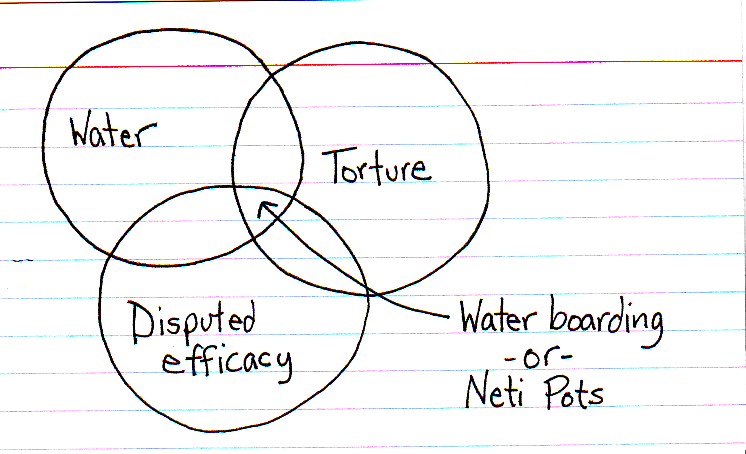
And lastly.... a bit of humor forwarded on to me by a patient who knows my love of the neti. I had to laugh... not that I agree, but it is darned funny :)

Sorry that I don't have a name to give credit to for creating this. The link to it is: http://thisisindexed.com/wp-content/uploads/2009/08/card2210.jpg